
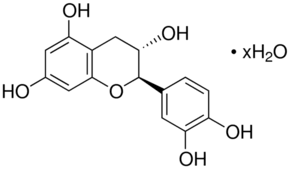
C72958 > 96% -500mg (±)-Catechin hydrate(Anhydrous)
€310.00
C72958 > 96% -500mg
(±)-Catechin hydrate(Anhydrous)
Synonym: trans-3,3′,4′,5,7-Pentahydroxyflavane, trans–
- CAS Number 7295-85-4 (anhydrous)
- Empirical Formula (Hill Notation) C15H14O6 · xH2O
- Molecular Weight 290.27 (anhydrous basis)
- Beilstein/REAXYS Number 92762
- EC Number 230-731-2
- MDL number MFCD00149354
- PubChem Substance ID 57653989
- NACRES NA.79
-
assay ≥96% (HPLC) form powder application(s) HPLC: suitable color white to light brown mp 200 °C (decomposes on heating) storage temp. 2-8°C -
General description
Catechin is produced by Cutch tree and is abundantly found in tea leaves, grape seeds, vegetables and plant-based beverages. It is a polyphenolic anti-oxidant[1] and acts as a plant secondary metabolite.[3]
Application
- (±)-Catechin hydrate has been used:
• to study its modulatory effect on drug resistance in human ovarian cancer cells[4]
• to construct the standard curve of total flavonoid content[5]
• to study its effects on the physiological parameters of Solanum lycopersicum[6] -
Biochem/physiol Actions
- Catechin has phytotoxic properties. Racemic catechin may be used in studies on seed germination and plant invasiveness.[2] Catechin and Epigallocatechin gallate (EGCG) may be used with other polyphenol flavonoids to study their effects in oxidation and peroxidation-related processes.[1]Polyphenolic antioxidant. Used in traditional Chinese medicine.
Description
C72958 > 96% -500mg
(±)-Catechin hydrate(Anhydrous)
Synonym: trans-3,3′,4′,5,7-Pentahydroxyflavane, trans–
- CAS Number 7295-85-4 (anhydrous)
- Empirical Formula (Hill Notation) C15H14O6 · xH2O
- Molecular Weight 290.27 (anhydrous basis)
- Beilstein/REAXYS Number 92762
- EC Number 230-731-2
- MDL number MFCD00149354
- PubChem Substance ID 57653989
- NACRES NA.79
-
assay ≥96% (HPLC) form powder application(s) HPLC: suitable color white to light brown mp 200 °C (decomposes on heating) storage temp. 2-8°C -
General description
Catechin is produced by Cutch tree and is abundantly found in tea leaves, grape seeds, vegetables and plant-based beverages. It is a polyphenolic anti-oxidant[1] and acts as a plant secondary metabolite.[3]
Application
(±)-Catechin hydrate has been used:
• to study its modulatory effect on drug resistance in human ovarian cancer cells[4]
• to construct the standard curve of total flavonoid content[5]
• to study its effects on the physiological parameters of Solanum lycopersicum[6] -
Biochem/physiol Actions
Catechin has phytotoxic properties. Racemic catechin may be used in studies on seed germination and plant invasiveness.[2] Catechin and Epigallocatechin gallate (EGCG) may be used with other polyphenol flavonoids to study their effects in oxidation and peroxidation-related processes.[1]
Polyphenolic antioxidant. Used in traditional Chinese medicine.


Reviews
There are no reviews yet.