
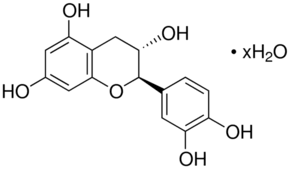
C22593-> 98% -500mg (+)-Catechin hydrate ≥98% (HPLC), powder
€220.00
C22593-> 98% -500mg
(+)-Catechin hydrate ≥98% (HPLC), powder
- CAS Number 225937-10-0
- Empirical Formula (Hill Notation) C15H14O6 · xH2O
-
assay ≥98% (HPLC) form powder color yellow to yellow with tan cast mp 175-177 °C (anhydrous) (lit.) solubility ethanol: 50 mg/mL storage temp. 2-8°C General description
Catechins are phytochemicals, richly present in black grapes, peaches, strawberries and broad beans. Catechins occur in various forms such as catechins, epicatechin, epicatechin gallate, epigallocatechin and epigallocatechin gallate.[1]
Application
- Molecular Weight 290.27 (anhydrous basis)
- Beilstein/REAXYS Number 3595244
- EC Number 205-825-1
- MDL number MFCD00150865
- PubChem Substance ID 57653982
- (+)-Catechin hydrate has been used:
• as a polyphenol standard in the determination of total polyphenols in the by-products of red wine[2]
• as an additive to study its effects on in vitro methane production and substrate degradation in a triple-fed batch approach[3]
• as a substrate to determine the activity of pure L. plantarum CECT 748T 14 recombinant tannase on catechin[4]Biochem/physiol Actions
An antioxidant flavonoid of plant origin; a free radical scavenger, preventing free radical-mediated damage in a variety of biological systems. For example, at physiological pH catechin suppressed DNA strand breaks by hydroxyl radicals. It has also been shown to prevent human plasma oxidation. It delayed the consumption of endogenous lipid-soluble antioxidants and inhibited lipid oxidation.
Description
C22593-> 98% -500mg
(+)-Catechin hydrate ≥98% (HPLC), powder
- CAS Number 225937-10-0
- Empirical Formula (Hill Notation) C15H14O6 · xH2O
- Molecular Weight 290.27 (anhydrous basis)
- Beilstein/REAXYS Number 3595244
- EC Number 205-825-1
- MDL number MFCD00150865
- PubChem Substance ID 57653982
| assay | ≥98% (HPLC) |
| form | powder |
| color | yellow to yellow with tan cast |
| mp | 175-177 °C (anhydrous) (lit.) |
| solubility | ethanol: 50 mg/mL |
| storage temp. | 2-8°C |
General description
Catechins are phytochemicals, richly present in black grapes, peaches, strawberries and broad beans. Catechins occur in various forms such as catechins, epicatechin, epicatechin gallate, epigallocatechin and epigallocatechin gallate.[1]
Application
(+)-Catechin hydrate has been used:
• as a polyphenol standard in the determination of total polyphenols in the by-products of red wine[2]
• as an additive to study its effects on in vitro methane production and substrate degradation in a triple-fed batch approach[3]
• as a substrate to determine the activity of pure L. plantarum CECT 748T 14 recombinant tannase on catechin[4]
Biochem/physiol Actions
An antioxidant flavonoid of plant origin; a free radical scavenger, preventing free radical-mediated damage in a variety of biological systems. For example, at physiological pH catechin suppressed DNA strand breaks by hydroxyl radicals. It has also been shown to prevent human plasma oxidation. It delayed the consumption of endogenous lipid-soluble antioxidants and inhibited lipid oxidation.

Reviews
There are no reviews yet.